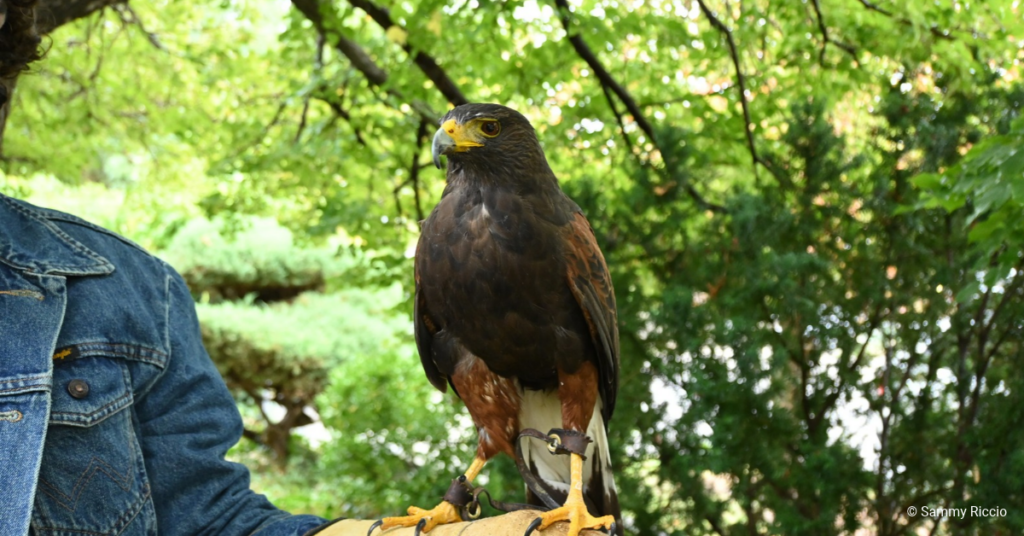
It’s a crisp October morning at the Commissary Ridge HawkWatch. It’s your second day visiting the migration site, and the count has been slow but steady, with mostly Swainson’s Hawks rising along the ridge lift then gliding south. You’re scanning the sky when a large silhouette appears over Wyoming Peak. A massive Golden Eagle flies overhead, the first of the day.
“Aren’t Golden Eagles the biggest raptor in North America?” you ask.
“I think Bald Eagles are bigger,” a crew member says.

Technically, you’re both wrong. Neither bird is the biggest raptor in North America (we’ll get to that later). As for which eagle is bigger, that depends on two things. First, it depends on how you define size. Bald Eagles tend to be heavier on average, while Golden Eagles usually have longer wings. Second, you have to consider the difference in size between males and females.
Raptors Break the Rules When it Comes to Size
In biology, the term “sexual dimorphism” refers to physical differences between males and females of the same species, such as body size or plumage. The word dimorphic comes from Greek roots: di- meaning “two” and morph, meaning “form” or “shape.” In almost all bird species, males are larger because they compete with each other to mate, defend territories, or monopolize resources, so being bigger is usually better.

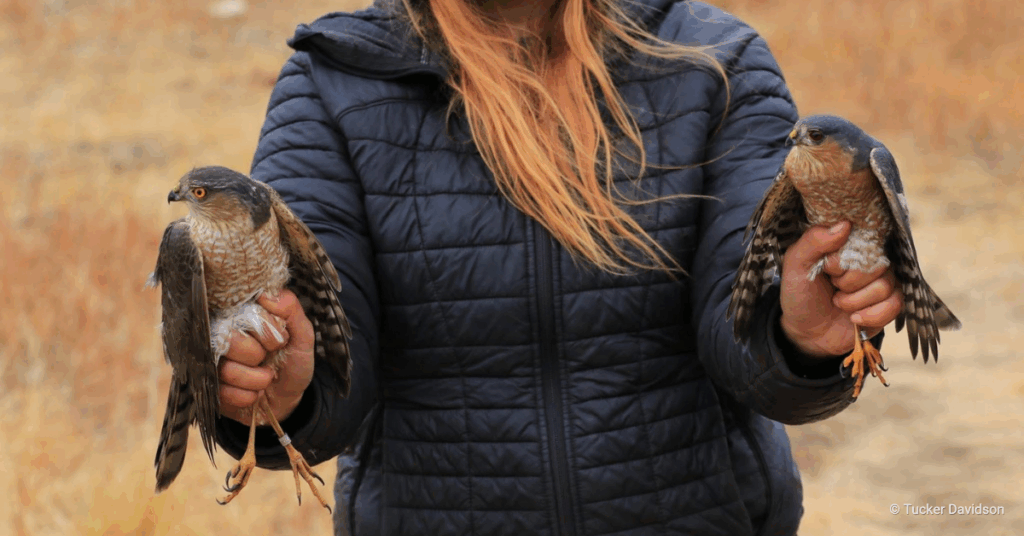
However, raptors stand out as one of the only bird groups where females are consistently larger than males. And not just by a little. An average female Sharp-shinned Hawk, for example, weighs 184 grams, while males average just 100 grams, a difference of 83 percent! For eagles, this means a large female Golden Eagle could outweigh a small male Bald Eagle, even though Bald Eagles are heavier on average. The reverse could be true for wingspan.
This phenomenon is called Reverse Sexual Dimorphism, or RSD, and it has been of interest to evolutionary biologists for a long time. In general, larger body size usually means better survival, especially in harsh conditions, because bigger individuals can store more fat and stay warmer longer due to a lower surface-area-to-volume ratio. You might guess, then, that RSD evolved because females got bigger. However, two major studies found that RSD in raptors is mostly driven by males becoming smaller, rather than females becoming larger.
Hunting, Habitat, and the Case for Short Kings
Biologists have put forth more than 20 possible explanations for Reverse Size Dimorphism. After decades of study, we now understand that RSD has less to do with survival and more to do with reproduction and the roles males and females play when raising young. In raptors, the female spends much more time at the nest, incubating the eggs, brooding nestlings, and ripping apart meat to feed the young. The male is mainly responsible for hunting and delivering food to the entire family.
Because providing food falls mostly to the dad, male raptors are under strong pressure to hunt efficiently and deliver a steady supply of prey to the nest. The best way to do this is to target smaller animals, which are more common in the environment but also faster and harder to catch. This is where being a smaller hunter becomes an advantage. Smaller raptors are more agile and better suited for chasing down quick, elusive prey. Over time, natural selection appears to have favored small males because the more food they delivered, the more chicks survived, and the more their “small” genes were passed on. In fact, one study showed that male goshawks decreased noticeably in body size over just 36 years in response to a shift toward hunting smaller, more agile prey when their larger prey (grouse) became scarce. The speed of that evolutionary change underscores just how important this small male trait is for reproductive success!
Where raptors hunt matters too. Species that live in complex habitats, such as forests with trees and thick underbrush, doubly benefit from smaller body size because it improves their maneuverability to hunt in tricky environments. A study comparing raptors from across the world found that species that hunt agile prey in complex environments tend to show the most extreme size differences between males and females.
Territorial behavior may also explain why male raptors evolved to be smaller, although to a lesser degree than prey size or hunting habitat. In many species, males compete for the best territories and breeding sites through high-speed flight displays or aerial chases. In this context, smaller, faster, and more agile males have an edge.
Are Female Raptors Getting Bigger?
While there is strong evidence that male raptors have shrunk in size, it’s worth asking whether females have also gotten bigger. Some researchers have explored whether larger females are able to rear more offspring or lay bigger eggs, which would lead to larger and more robust chicks. However, when scientists compared species across the board, they did not find a link between female size and egg or clutch size.
There is, however, scientific support for the hypothesis that female raptors have evolved to be bigger to aid in nest defense. Females spend more time at the nest, which means they are often the last line of defense between their young and an attacker. A heavier mom can strike harder, deliver more damage with her talons, and pose a more lethal risk to any animal threatening the nest. In Prairie Falcons, simply the presence of a bigger and more imposing female near the nest may help deter attackers. If larger females are more successful at defending their young, then their “larger” genes would pass on to the next generation, contributing to the evolution of bigger females.
More research is also needed to test other interesting hypotheses. For example, some biologists have proposed that sexual selection might play a role, with smaller males being more attractive for their increased agility during courtship displays (the leading explanation for RSD in shorebirds). Another hypothesis posits that size differences could help reduce food competition between the sexes, allowing males and females to specialize in different prey. There’s still more to learn about RSD, but at least one thing is certain: when it comes to feeding a family, being small is a big advantage.
Back on the ridge, the Golden Eagle winks out into the sky. A rare blip of cell service gives you just enough time to settle the debate. The largest raptor in North America isn’t the Golden Eagle or the Bald Eagle, it’s the California Condor. With a wingspan of nearly 10 feet and a body mass of over 20 pounds, no other bird of prey on the continent comes close. You also learn that male and female vultures, including condors, are roughly the same size. The wind shifts. A Turkey Vulture drifts overhead, buoyant and wobbly, wings in a clear dihedral.
“Why are Turkey Vultures the same size?” you question out loud. As your bars disappear again, you lean back against the rock fortress with a PB&J and begin to ponder.
This blog was written by Dr. Jordan Herman, HWI’s Conservation Biologist. You can learn more about Jordan here.
All birds were handled for the purpose of scientific research under a federally authorized Bird Banding Permit issued by the U.S. Geological Survey and in accordance with all state permitting requirements.
Sources
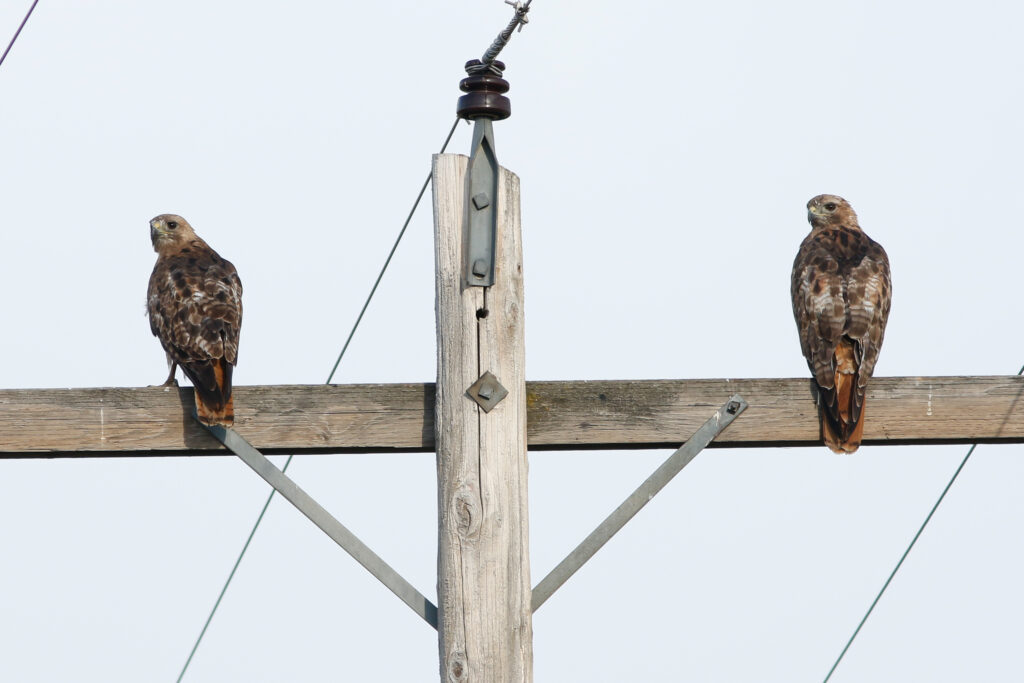
Photos in order by Tucker Davidson, Jordan Herman, Cody Allen, and Neil Paprocki.
Birds of the World. (n.d.). Cornell Lab of Ornithology. Retrieved from https://birdsoftheworld.org
Holthuijzen, A. M. A., & Oosterhuis, L. (2024). Parental roles of nesting Prairie Falcons in relation to reversed sexual dimorphism. Journal of Raptor Research, 58(1), 54–69. https://doi.org/10.3356/jrr-22-78
Krüger, O. (2005). The evolution of reversed sexual size dimorphism in hawks, falcons and owls: A comparative analysis. Evolutionary Ecology, 19(5), 467–486. https://doi.org/10.1007/s10682-005-0293-9
Pérez‑Camacho, L., Viñuela, J., Alonso, C. L., & Mougeot, F. (2018). Structural complexity of hunting habitat and territoriality increase reversed sexual size dimorphism in diurnal raptors. Journal of Avian Biology, 49(10), e01745. https://doi.org/10.1111/jav.01745
Schoenjahn, J., Pavey, C. R., & Walter, G. H. (2020). Why female birds of prey are larger than males. Biological Journal of the Linnean Society, 129(3), 532–542. https://doi.org/10.1093/biolinnean/blz201
Tornberg, R., Mönkkönen, M., & Pahkala, M. (1999). Changes in diet and morphology of Finnish goshawks from the 1960s to the 1990s. Oecologia, 121(3), 369–376. https://doi.org/10.1007/s004420050941