
Global Raptor Research and Conservation Grant
Update to Priorities—Fall 2025
Previously, HWI has prioritized grants according to the Raptor Research and Conservation Priority Index (RCPI), which ranks all raptor species according to their threat status and the number of scientific publications on the species, with more threatened and less-researched species rated as higher research priorities (Buechley et al., 2019). However, over the past five years, some of these rankings have shifted due to significant research attention and reclassification of threat status. Additionally, recent work has quantified the evolutionary distinctiveness of all bird species and combined this with their threat status to present the EDGE score, which can be used to prioritize research (McClure et al., 2023).
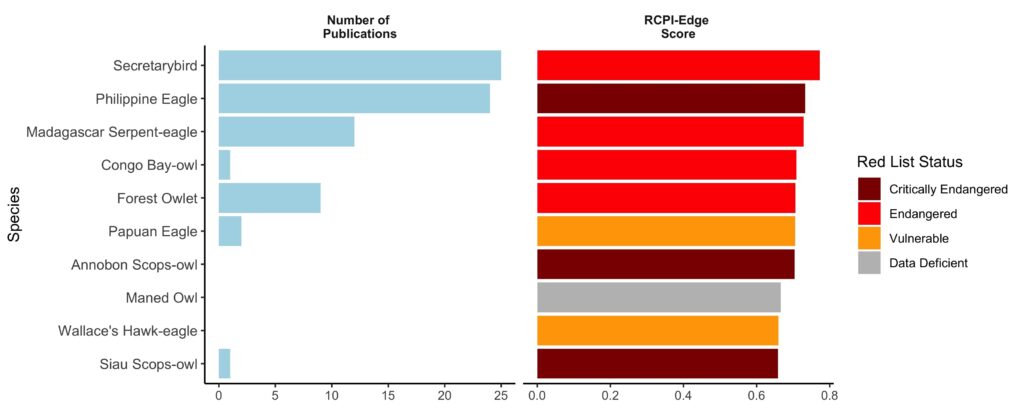
We have updated the RCPI score using the most recent (2025) IUCN RedList categories to calculate EDGE scores (following McClure et al., 2023) and combined this value with the number of publications per species. We consider “priority species” as all raptors with an RCPI > 0.5 (n = 158 species, 28% of raptor species).
Why did HWI change its priorities?
Over the past five years, some of the initial RCPI rankings have shifted. Some previously understudied species have received significant research attention (e.g. published research on Hooded Vultures has increased by nearly 185% since the grant inception, now at 77 publications). Others have undergone reclassification of threat status (e.g. Flores Hawk-eagle moved from Critically Endangered to Endangered, and Grey-backed Hawk from Endangered to Vulnerable, Cryptic Forest-falcon and Banggai Scops-owl both from Least Concern to Near Threatened).
Reclassifications have occurred for a number of reasons, including real measured changes in abundance or distribution, or improved understanding of these factors. Our appreciation of the need to conserve genetic diversity has also shifted, with a drive to focus conservation efforts on the more phylogenetically unique (i.e. evolutionary distinct) species (McClure et al., 2023). Measuring the evolutionary distinctiveness of a species requires an understanding of the evolutionary history and relatedness to other species, but in essence, species that are more evolutionarily distinct (like the Philippine Eagle and the Secretarybird) have no similar relatives and are often the only species in their genus. Recent work has quantified the evolutionary distinctiveness of all bird species and combined this with their threat status to present the EDGE score, which can be used to prioritize research (McClure et al., 2023), although it negates how much research effort has already occurred.
The number of scientific publications available for a species does not always reflect conservation effort on the ground (Guénard et al., 2025), but it is the best measure we have available to quantify research effort. Some species may have established conservation programs underway, but results might be contained within funding reports rather than published in scientific journals. Furthermore, some publications do not directly influence conservation actions on the ground. Nevertheless, at our latest count, there are around 25,688 publications on raptors (Sept 2025, using a Scopus search for all manuscripts including each species names; there may be some duplicates). Although impressive, this research is strongly biased toward a few species. Of the 561 raptor species worldwide, 96 species (17%) have no publications to their name, while nearly 50% of the publications are on just 20 species (4%). The species with the most research effort have wide distributions and stable populations. The top three most studied raptors are: Barn Owl (number of publications = 1,277), Peregrine Falcon (995), and Bald Eagle (815). At the other end of the scale, we cannot expect to conserve species with no research.
What is a Priority Species?
To rank priority species for the Global Raptor Research and Conservation Grant, we have updated the RCPI score using the most recent (2025) IUCN RedList categories to calculate EDGE scores (following McClure et al., 2023) and combined this value with the number of publications per species. We consider “priority species” as all raptors with an RCPI-Edge > 0.5 (n = 158 species, 28% of raptor species).
What kind of work does the grant support?
The Global Raptor Research and Conservation Grant supports local researchers working on priority raptors to close critical knowledge gaps and/or implement effective conservation strategies. Projects do not need to fulfill both of these aims directly, but it must be evident how they will contribute to improving the conservation status of the target species.
The grant funds ecological research that helps us to understand how the most threatened, unique, and understudied raptors live, interact with their environments, and respond to threats. Projects may include studies on diet, movement ecology, breeding biology, habitat use, or population dynamics. For priority species with little or no scientific study to date, surveys to assess population status and distribution are also encouraged. The ultimate goal is to generate insights that strengthen our understanding of raptors and provide information for effective conservation planning.
In addition, the grant supports applied conservation efforts that directly reduce threats and improve survival prospects for priority or little-known raptors. These may include conflict mitigation, habitat restoration, community-based conservation and education programs, policy engagement, or other interventions that turn knowledge into measurable conservation outcomes for raptors and the ecosystems they depend on.
Minimum Requirements
- Focused on a single species of raptor that is recognized as a high-priority species for research and conservation (>0.5 RCPI-Edge*)
- Projects must be focused on a raptor species that is recognized as a priority (RCPI >= 0.5) as per the most recently published list
- Work must be led by the applicant
- Led by an applicant who is a citizen or permanent resident of the country or region where the project will take place
- Led by an applicant who is associated with a registered NGO and/or university in the country where the project will take place
Preferences
Applications will be scored based on the importance and/or impact of the proposed project, the overall quality of the application, and the applicant’s financial need. Furthermore, preference will be given to projects that:
- The maximum funding ($3,500) will make up a significant proportion (50%+) of the total budget;
- Are undertaken by researchers with a demonstrated commitment to raptor research (e.g., by proven track record or clear commitment to a career in raptor research)
- Fill knowledge gaps on species with no prior research
Restrictions
Due to funding limitations, we are unable to review applications that…
- Occur in the USA, Canada, or Europe
- Focus on a raptor species with RCPI-Edge* < 0.5
- Occur outside of the country where the applicant is a citizen or permanent resident
- Are submitted in any language other than English
- Cannot complete all grant outputs within 18 months of receiving the grant
- Lack a relationship with a registered NGO or university that has agreed to accept the grant and disburse it to the applicant