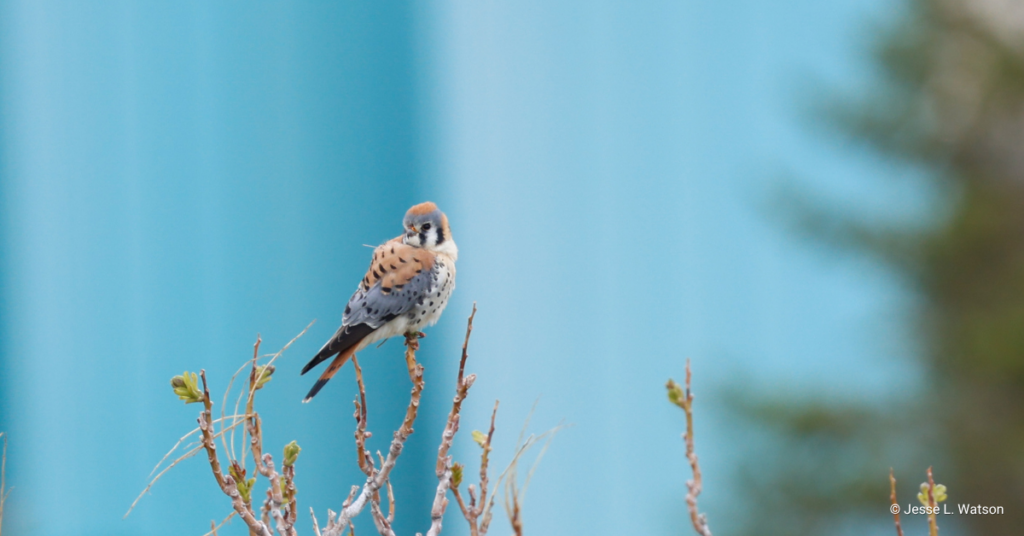
Ever-evolving wildlife tracking technology transforms how we understand animal movement. Individuals carrying GPS transmitters provide a window into understanding parts of their lives we could never observe directly, such as migration routes, seasonal ranges, daily movement patterns, and even how they use the landscape. As GPS tracking devices improve, so does the level of detail in the data we collect. However, even with these advances, few devices are small and lightweight enough to be carried by smaller raptors while still collecting enough data to answer more detailed questions. Despite these challenges, we are excited to share results from one of the most comprehensive (and ongoing) studies of American Kestrel breeding home ranges to date.
How We Track American Kestrel Movement
The American Kestrel is North America’s smallest falcon, weighing in at an average of 105 g for males and 125 g for females (for reference, a standard deck of cards is 100 g). Because of their small size, we have to be careful not to use tracking devices that are too heavy or bulky. That means making a tradeoff: either collect fewer data points, or use a unit that cannot transmit data remotely. We chose the latter. This allowed us to collect enough data to answer questions like, “How big is the breeding home range of an American Kestrel?”, but it also meant we had to recover the units and physically connect them to a computer to download the data.
This required catching the bird twice—once to deploy the GPS unit, and again to retrieve it. Luckily, American Kestrels share parental duties, with both the male and female incubating the eggs. For most deployments, we block the entrance to the nest box with the adult inside, carefully pull the bird out, then put the GPS unit on like a tiny backpack. After three to four weeks, we try to catch the bird again. Except during this time, the adults don’t spend very much time inside the box, so we often catch them in nets outside the box. As you might imagine, this is not an easy task and requires some creativity and patience. Sometimes we were lucky and caught a bird in under a minute, but many times it took several hours spread over several days.
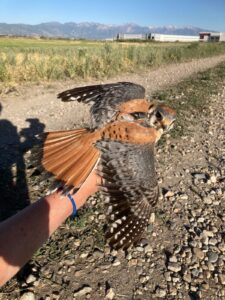
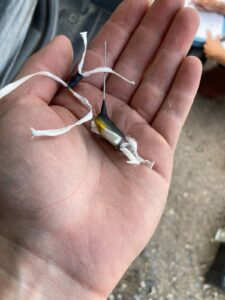
To date, we have deployed 154 GPS units on kestrels and recovered 110 (and counting!). The results shared here reflect data from the 73 we had collected from the 2021-2023 breeding seasons.
What We Learned From GPS Tracking
After retrieving the GPS units and processing the data, we began to see just how variable kestrel movement can be. Some individuals stayed close to the nest, spending most of their time perched in trees or on fence lines. Others ranged much farther, taking several trips a day into the mountains or across a lake. The smallest home range was 0.01 km², staying within 100 meters or so of the nest, and the largest was 135.6 km², traveling about 18 km from the nest!
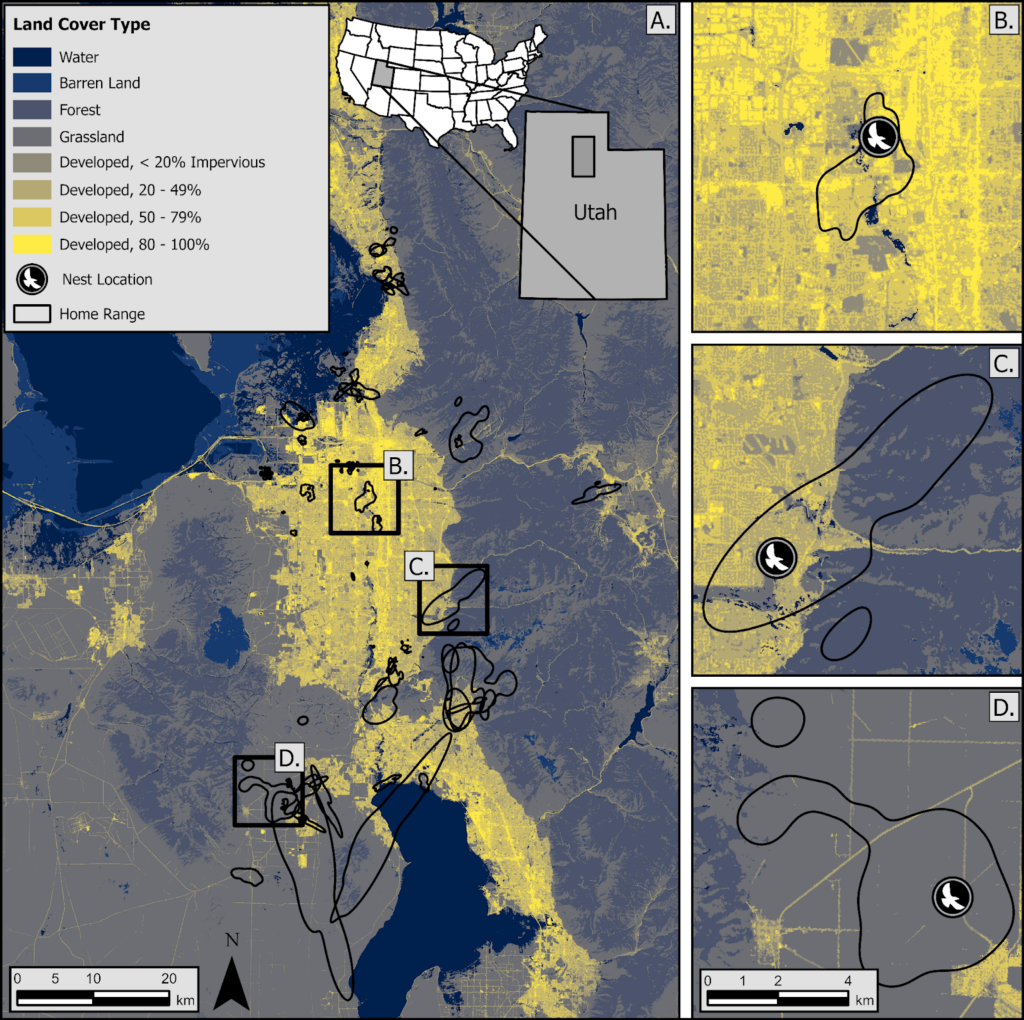
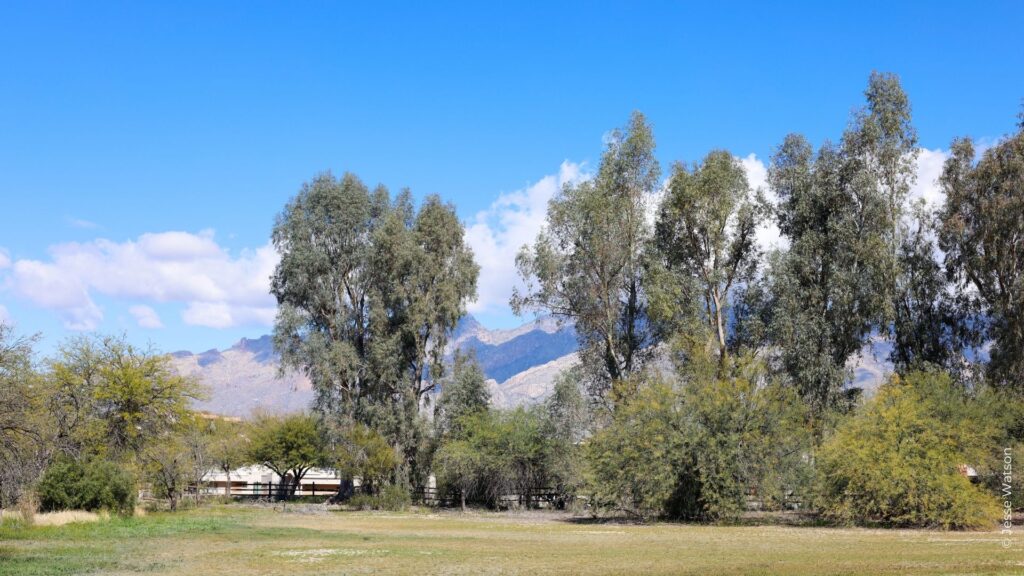
Females generally had smaller home ranges than males (by about nine times), although there was considerable overlap. Only one female had a home range larger than her mate, though the two were very close in size (about 2.85 km2). Landscape also played a role in home range size, with urban-nesting birds tending to have smaller home ranges than those in more rural environments. Many of the birds with larger home ranges, both male and female, were in close proximity to the mountains they visited daily.
| Minimum | Maximum | Median | |
| Female | 0.01 | 24.4 | 0.4 |
| Male | 0.37 | 136.0 | 3.8 |
One of the more surprising patterns emerged from GPS points collected in the middle of the night. In many cases, adult kestrels weren’t roosting near their nest boxes at all. Some stayed relatively close—maybe 500 m or a few kilometers—but others roosted 10 or even 20 kilometers away, often in areas completely different from their daytime ranges. Findings like these would likely not have been possible without these trackers.
Want to Learn More?
This research was part of my master’s work at Boise State. If you want to take a deeper look at my work, check out our recently published article, Nesting in urban areas affects Falco sparverius (American Kestrel) home range size and adult female health, in Ornithological Applications: https://hawkwatch.org/wp-content/uploads/2026/03/duag025.pdf
This is just the beginning of addressing some of the questions that deploying these GPS trackers can answer—stay tuned for more!
None of this would be possible without the hard work and dedication of our team. Over 80 community scientists monitor boxes and submit data from March to July each year, in addition to HawkWatch International interns, technicians, and biologists who helped deploy and retrieve each GPS unit. This would not be possible without you all!
Want to support this work? Adopt-A-Box! Your gift will cover the cost of materials to build one box in our study area, replacing worn nest boxes after many seasons of use. Click here to Adopt-a-Box: https://hawkwatch-international.myshopify.com/products/adopt-a-box
This blog was written by Jessica Taylor, HWI’s Research Biologist. You can learn more about Jess here.