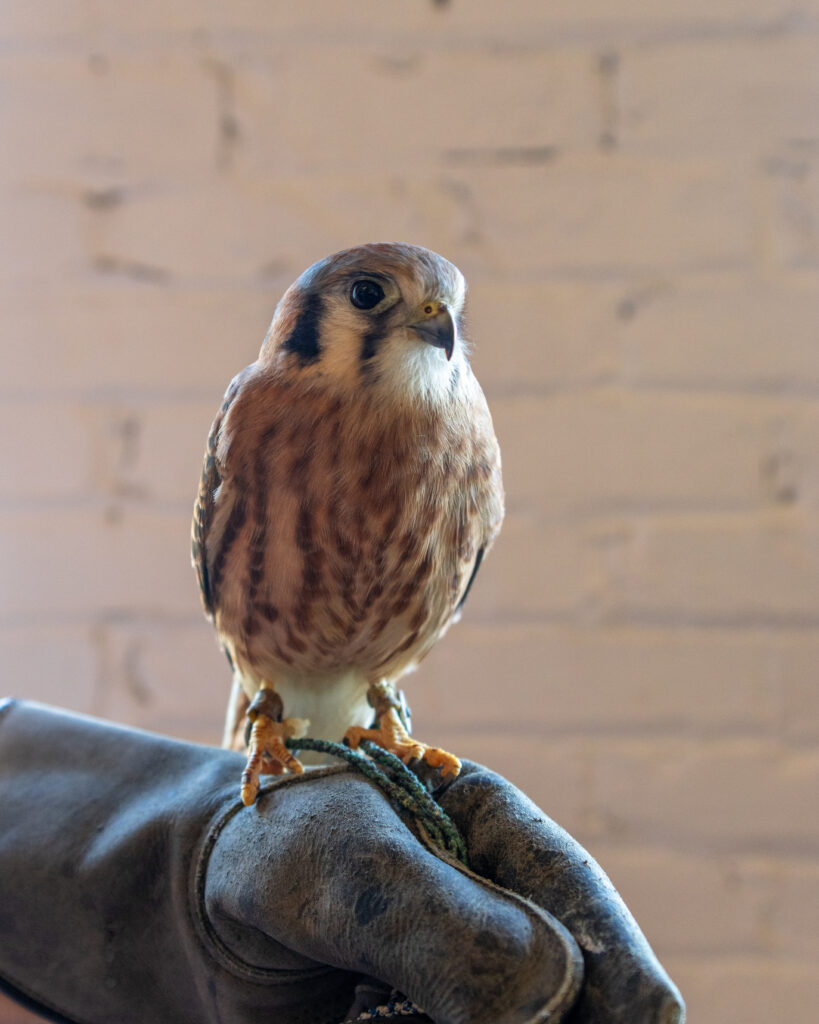
This summer, we welcomed Liggy the American Kestrel to our team of Raptor Ambassadors. Liggy arrived at a local wildlife rehabilitation center already deeply imprinted. She had no fear of humans and happily hopped onto a hand without hesitating. This was most likely due to humans keeping her in their home for an extended period of time before realizing it might not be fun to have a wild raptor for another 15-20 years. Liggy will never be able to live in the wild because she will always view humans as a source of food and protection. With that in mind, we brought Liggy onto the team. Her name is in honor of Jerry Ligouri, our late friend, raptor conservationist, photographer, and former educator at HawkWatch International (HWI). You may have seen Jerry’s name on one of the many raptor books or photos he published in his lifetime.
Given Liggy’s background, you’re probably not surprised she became a Raptor Ambassador. But that’s not the story for every bird that ends up as an ambassador. So what makes a bird a good candidate for a life educating humans?
Where do Raptor Ambassadors Come From?
You can find animal ambassadors at zoos, nature centers, aviaries, aquariums, universities, and nonprofit organizations like HWI. These animals can come from a wide variety of places, but all of them are subject to state and federal rules and regulations. The agencies responsible for permitting exotic animals can vary depending on the type of animal, whether or not it’s Endangered, and if the animal is native to the local habitat or being brought in from out of the state or country.
When it comes to raptors native to North America, all permits for ambassador animals are managed by the US Fish and Wildlife Service (USFWS) as part of the Migratory Bird Treaty Act. Native Raptors are closely monitored, and the permit process is there to ensure they only go to homes that can give them a good quality of life. What’s more, the special use permits we hold from USFWS are specifically for education, meaning our birds are required to be used in programs that promote conservation and provide information about the ambassadors’ wild counterparts.
Raptors used in programs like ours can come from breeders who raise them specifically for life with humans. However, at HWI, we acquire all our birds from licensed wildlife rehabilitators when it becomes clear that they won’t be able to be released. These are birds that have injuries or imprinting that prevent them from hunting, migrating, or defending themselves, and if they didn’t go to a place like HWI, they would most likely be euthanized. Sadly, there are far more raptors that need life-long care than there are spaces for them in education programs. While we can’t take every bird that comes our way, we feel that, for the right candidate, life as a Raptor Ambassador can be comfortable and impactful. Birds that are more skittish, aggressive, or stressed by humans may be placed on display at a zoo, aviary, or nature center or placed with a licensed falconer for use in hunting.
How We “Hire” a Raptor Ambassador
What makes a bird a good candidate for a life educating humans? It turns out there are several factors involved. Birds like Liggy that are very comfortable with humans are generally the best option. We ask a lot of our Raptor Ambassadors, so there are many factors to consider before bringing a new bird into the program.
Space and Program Needs
The first things we consider are if we have a suitable space for the bird and if it is a good candidate for our program. Our federal permits require that our birds have suitable housing, medical care, dietary management, and frequent opportunities to provide education programs. Our birds live in structures, called mews, that are essentially like their private bedrooms. We won’t take a bird, even a really exciting bird, unless we are positive we have the space to house it safely and comfortably for the remainder of its natural life.
Some birds are more fitting for us than others because they are related to our long-term monitoring and scientific research work. As an American Kestrel, a species we have been studying for over a decade, Liggy was a perfect ambassador for us to use in talking about Cavity-Adopting Raptor Ecology Studies (CARES), a project that is looking at kestrels and small owls that nest in holes.
Species and Individual Personality
There are some raptor species that naturally have temperaments better suited to life as a Raptor Ambassador. There is a reason so many raptor programs use Red-tailed Hawks, Harris’s Hawks, and screech owls. These species generally tend to adjust well to the presence of humans. American Kestrels are one of the species that readily adapt to life as educators. On the other hand, you will almost never see a Cooper’s Hawk or an Osprey used on the glove in an education program because they are notoriously difficult to keep well in captivity and generally too nervous to work on a glove.
Even a bird from a species more likely to adapt to life as an educator isn’t always going to be a good fit. In addition, the individual bird needs to have the right personality for the work. Some birds are simply more confident and curious than others. These birds tend to be more comfortable and willing to work. We always meet a bird and evaluate its temperament before accepting it into our program.
History
Imprints like Liggy are naturally easier to work with since they have already adjusted to the presence of humans. In fact, since Liggy has spent her entire life with humans, she actually seems to enjoy having us around. Unfortunately, we don’t have a full history of human interactions for some of our birds. In these cases, we have to figure out what they like or don’t like based on careful observation. A bird that has been mistreated by humans, or even treated well but subjected to stressful situations like extended medical care, may never feel calm enough around them to be handled on a glove. Some birds are triggered by seemingly random things like people wearing hats or glasses. This may be due to a perceived threat from a human who wore those things in the past. When choosing a bird for our program, we do our best to get as much of its history as possible to determine if the bird can adapt to the role. When we meet a bird that shows a lot of fear or mistrust, we generally won’t accept them into our program, which may prove too stressful for them.
Handling Skill and Experience
Some birds simply require more skill and experience than others. As a program that relies on volunteer docent help, we are always careful to choose birds that can easily be handled by a variety of people. Birds that tend to attach strongly to a single person won’t be happy with us, so we tend to avoid them. We also consider the size, strength, and, for lack of a better term, feistiness of a bird before adding it to our team. Some birds are just too powerful or intimidating to be handled by some people, and not all our docents are able to work with every Raptor Ambassador. In the end, the birds have the final say over who gets to handle them, and we tend to favor birds that are willing to work with multiple handlers.
At this time, HWI continues to utilize birds that can’t survive on their own in the wild due to imprinting or injury. We have a fantastic team caring for our birds, and we feel that the potential they have to inspire learners to embrace conservation and speak up for wildlife makes their lives meaningful. If you have never had the chance to gaze into a raptor’s eyes, please join one of our free outreach programs and see our ambassadors for yourself. Meeting a bird like Liggy may just change your life.
To see upcoming Raptor Ambassador Events, visit our calendar here.
This blog was written by Melissa Halvorsen, HWI’s Education and Outreach Director. You can learn more about Melissa here.