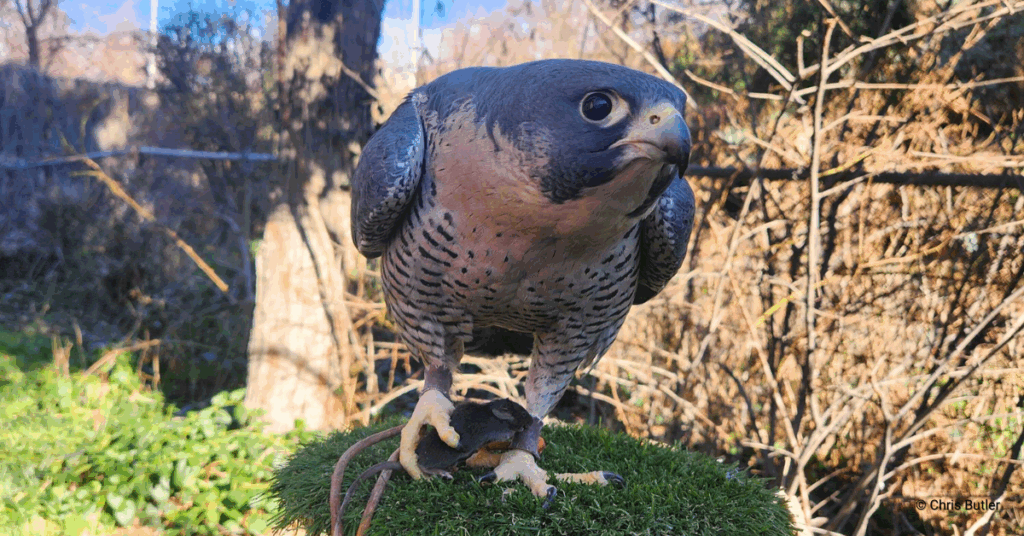
At education programs, we tend to hear a few questions all the time: How old are the birds? Are they boys or girls? Do they like you? What do you feed them? The answers to the first three questions are between about 3 and 25 years old; there are 6 girls and 4 boys; and kind of maybe. As for what we feed them, that’s a longer answer.
HawkWatch International has 10 Raptor Ambassadors (what we call our birds), each with their own needs and diet. Between the 10, they eat mice, rats, quail, chicken, rabbit, crickets, fish, and deer. You might be wondering, “What about fruits and vegetables? dessert?” While our human staff love those options on their own plates, our raptor colleagues are strictly carnivorous, meaning they don’t eat anything besides meat.
No Hunting Allowed
A common follow-up question is, “Are the food animals alive?” The answer is a resounding no. Our birds are with us because we have education permits from both the U.S. Fish and Wildlife Service and the USDA. Birds on these permits are unreleasable back into the wild because they cannot hunt successfully or take care of themselves, as determined by wildlife rehabbers and veterinarians. That means our birds either don’t know how to hunt or they have injuries that make hunting too difficult or too dangerous. So, live feeding doesn’t work for them—some of them would just stare if a mouse ran around in their mew. We have seen this play out when our birds are perched out of their mews while we clean. Squirrels will be running around, and despite them getting in range of a possible attack, none of our birds have ever even shown a half-thought about hunting them. Feeding live prey can be inhumane for both predator and prey. A rat, for example, may fight for its life, resulting in injuries to our birds and a potential slow, painful death for the rat. The easiest and best thing for our birds is to be fed food that is already dead.
We source our food mainly from a company called RodentPro, where we spent roughly $12,000 in 2025. The company specializes in the production and distribution of premium-quality feeder animals. I order several months’ worth about four times a year, which we then unpack and sort into freezers by type and size. We pay attention to the color of fur on mice and rats: mice are black or white, while rats are black, white, brown, gray, or a combination of colors. Why? That’s an interesting answer that I’ll explain in a bit.
How to Meal Prep for Picky and Not-So-Picky Eaters
Every day, we pull frozen food from the freezers and put it in the fridge to thaw for the next day’s feeding. After they’ve thawed, we weigh the food and enter it into a spreadsheet for tracking, then offer food to each bird, and they choose how much to eat. We will enter how much food the birds don’t eat, called scrap, in the spreadsheet as well. Of course, we have a good idea of how much each bird is going to eat each day, based on the bird’s typical diet in the wild, current weight (they get weighed daily), and preferences, along with the time of year (they get more food in the colder months), and advice we get from veterinarians and wildlife rehabilitators.
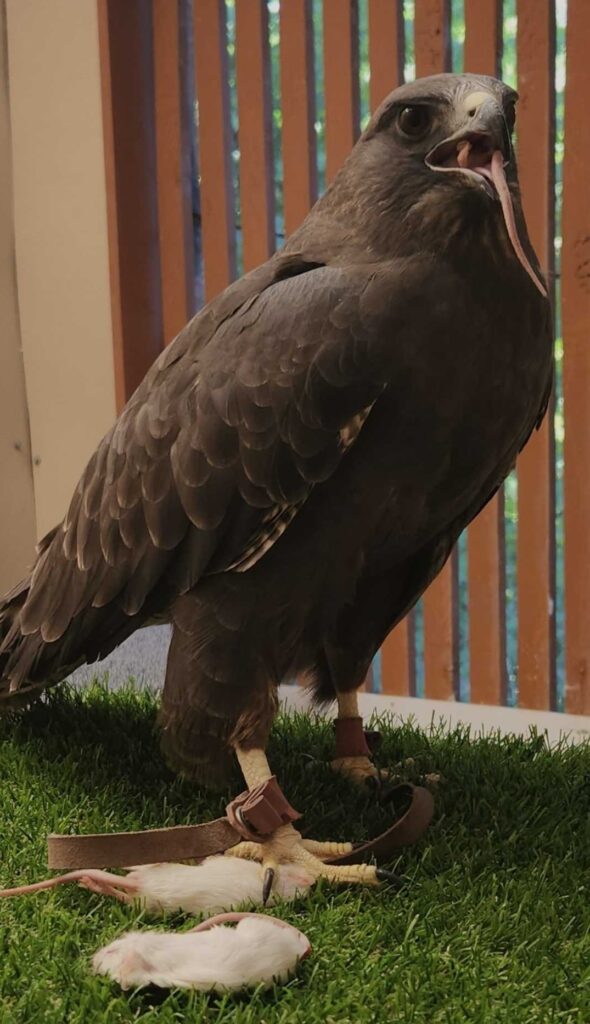
Our Swainson’s Hawk, Aurora, is one case where we’ve needed to adjust diet plans. In the wild, Swainson’s Hawks primarily eat rodents in North America, where they spend the breeding season, and insects like grasshoppers in Argentina, where they are during the nonbreeding season. Aurora came to HawkWatch International when she was three years old, so she had likely migrated to Argentina twice and eaten many different animals to survive. Because flying to Argentina is a lot of work, Swainson’s Hawks must gain weight to survive the flight. Aurora is no exception and, at the end of August, her weight steadily climbs. The funny thing is, we don’t feed her any extra food, but every fall her weight goes from around 950-1,000 grams to 1,200-1,250 grams. The only behavioral change we’ve seen is that she eats faster. Another funny thing about Aurora is that she will eat only all-white mice and rats, with one exception—once, she ate a rat that was about 80% white and 20% black. Aurora is one of the reasons we pay attention to the color of the food.
Another diet example comes from Jack, who is a Merlin, a type of small falcon. He is different from Aurora and many of our other birds because his weight is almost always 145-155 grams. He stays in that range whether he eats everything or nothing (though he often is closer to everything). In the wild, Merlins mainly eat other birds, such as finches, but they also eat rodents and insects. We feed Jack both mice and birds. We used to feed him quail, but noticed he left more scrap from them than from the mice. We switched to feeding chicken in the form of small chicks, and they were a hit! Jack seems to enjoy plucking all the small downy feathers off before devouring the little birds. As for the color of the mice? Jack hasn’t shown a preference like Aurora, but mostly gets dark mice because that is the color of the smaller mice we buy.
These are just two examples, as every HawkWatch International Raptor Ambassador has their own meal plan. We keep careful notes every day on what each bird is eating and leaving behind, and make adjustments as needed to ensure they are comfortably fed throughout the year.
Want to see for yourself what our Raptor Ambassadors eat? Feed them a rat! Talon-tine’s Day is the one time a year that you can name a rat after someone else and have it fed to one of our birds. We’ll even send you proof: https://hawkwatch-international.myshopify.com/collections/talontines-day
HWI Educator Chris Butler wrote this blog and took the photos includedd as well. You can learn more about Chris here.