Golden Eagles are a Species of Greatest Conservation Need (SGCN) in Utah due to habitat loss, prey declines, and human-caused mortality. Golden Eagles in the West Desert are among the best-studied in the world, with long-running nest monitoring, banding, satellite tracking, and prey monitoring efforts, making Utah an ideal study site for our Golden Eagle Winter Ecology Study. Golden Eagles in the West Desert of Utah have some of the lowest reproduction and first-year survival rates in the West (e.g., ~50% vs 70% west-wide). To learn more about these declining survival rates, we began monitoring the changes in eagle reproductive and survival rates in response to the provision of large mammal carcasses in eagle winter hotspots.
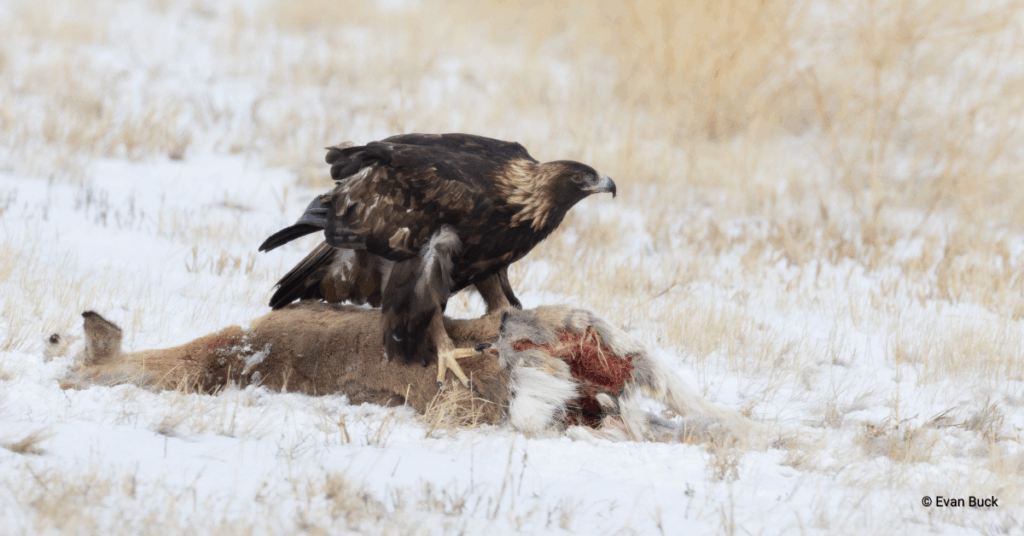
Four years ago, our team launched the Golden Eagle Winter Ecology Study with a dual-purpose approach: first, to monitor the movements of Golden Eagles by observing color bands as eagles visited feeding sites, and second, to quantify the impact of these supplemental food resources. We set up camera traps throughout Utah’s West Desert, baited with carcasses mostly collected as roadkill and redirected from their typical destination (landfills), back into the natural environment. Our hope was that this would support the eagles’ over-winter survival and increase nest productivity for nearby territories.
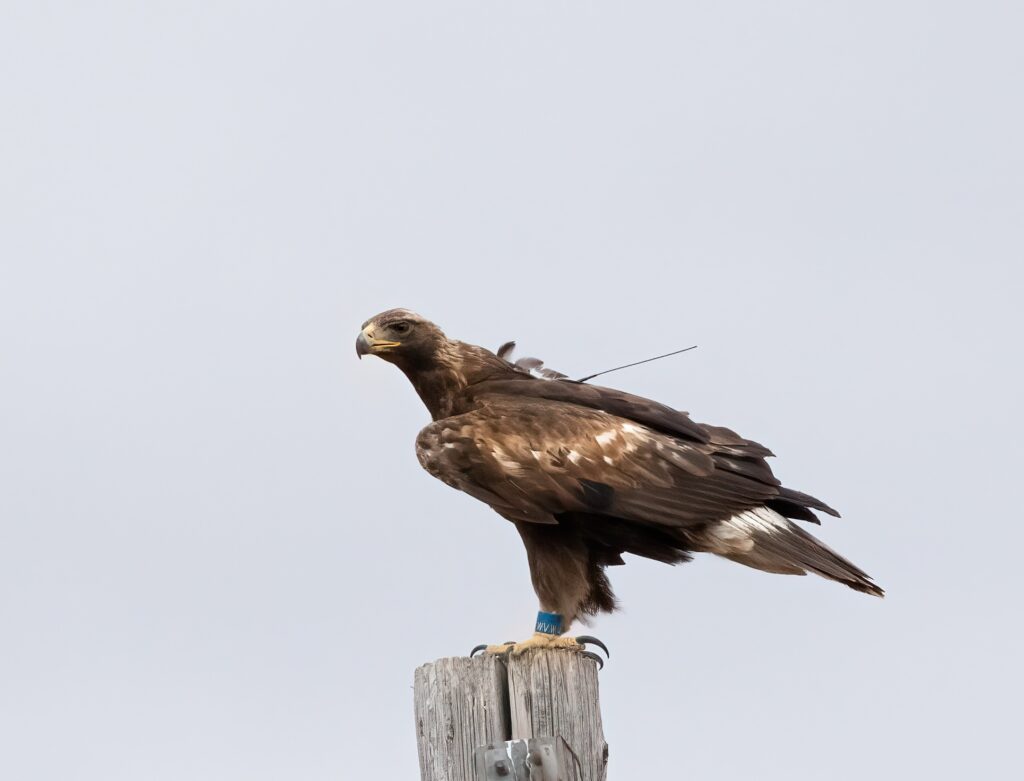
So far, our efforts have given us novel information on the wintering behavior of eagles, particularly around feeding and survival. A single sighting of a banded Golden Eagle is a relatively rare and exciting event, yet we’ve resighted bands from 20 unique individuals, with a total of 94 resightings! In addition, we’ve recorded 446 eagle weighing events, with an extra 135 added in the current 2025-26 season as of February 3, 2026. The eagles spent over 387 hours on Passive Perch Scales, with over 150 additional hours logged so far this winter. These scales have allowed us to track changes in the birds’ mass as they feed, revealing fascinating details about their feeding behavior. If you would like to learn more about the passive perch scales, check out my previous blog, Weighing The Future of Golden Eagle Conservation!
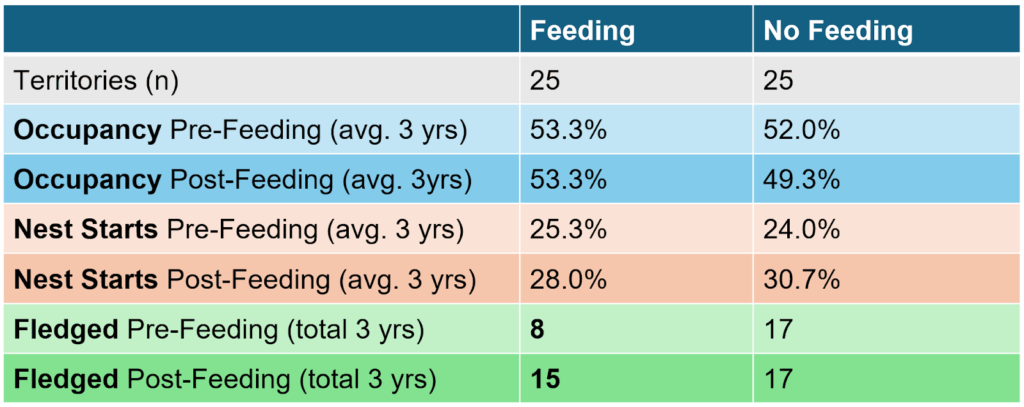
By comparing 50 total territories (25 with supplemental winter feeding, 25 without) between three “pre-feeding” years and three “post-feeding” years, we gained valuable insight into the within-year carryover effect of feeding sites on nest success. The average number of territories occupied by a breeding pair (occupancy) and the number of occupied nests with viable eggs or nestlings (nest starts) between feeding and non-feeding sites were nearly identical across both periods, with only minimal differences. However, before feeding began, nest success at feeding sites was much lower, with only half as many eaglets fledged compared to non-feeding territories. After we introduced carcasses, territories near feeding sites nearly doubled the number of fledged eagles! This finding lends support to the idea that adult body condition–the overall health of the bird’s body–at the start of the breeding season greatly influences nest success, and that eagle conservation needs to look at more than just nesting-season activities.
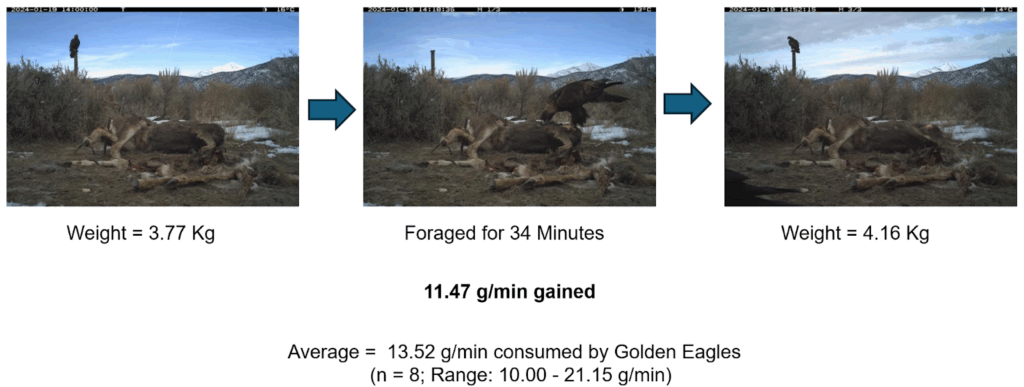
The implementation of passive perch scales has also allowed us to observe individual feeding events in detail. For example, we documented a sequence in which a Golden Eagle was weighed on a passive perch scale before feeding, then returned to the scale after feeding for 34 minutes. We found that it gained 390 grams. Through multiple events like this one, we’ve seen that when carcass condition is optimal (i.e., still relatively fresh), Golden Eagles consume an average of 13.5 grams per minute.
By quantifying how much Golden Eagles eat and how quickly they gain mass, Passive Perch Scales allow us to estimate exposure levels when birds feed on carcasses; this is especially important because Golden Eagles are highly susceptible to lead poisoning due to their scavenging behavior, and even small amounts of ingested lead from bullet fragments can have serious impacts on their survival. These measurements move risk assessment beyond assumptions and support evidence-based decisions for applied conservation actions aimed at reducing lead-related impacts on Golden Eagle populations.
Our ongoing study continues to shed light on the winter ecology of Golden Eagles and demonstrates the potential benefits of targeted conservation efforts. We look forward to sharing more updates as our research progresses and our understanding deepens.
The Golden Eagle Winter Ecology program is made possible by supporters like you. Special thanks to the JAKA Foundation, Dugway Proving Ground, Great Salt Lake Audubon, David Slater, and our Golden Eagle Camera Club members for supporting this project!
You can also play a part in conserving Golden Eagles! Sign up for the Golden Eagle Camera Club and adopt your very own camera pointed at one of our Passive Perch Scales. You’ll get photos of everything that visits your perch, from majestic Golden Eagles to curious Loggerhead Shrikes. Every site has its own story, and we’d love for you to be a part of it!
Have your own photos of color-banded Golden Eagles? Report your sightings here, and one of our scientists will tell you all we know about the banded bird you’ve seen.
This blog was written by Cody Allen, HWI’s Field Biolgist You can learn more about Cody here.