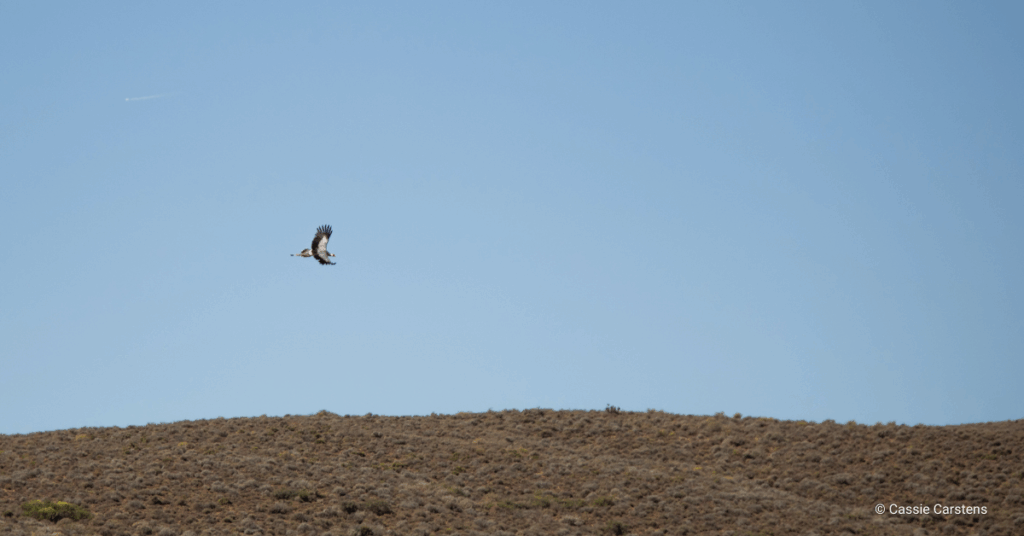
For a moment, it seemed like another setback for Secretarybirds.
Director of International Programs, Dr. Megan Murgatroyd, watched the map as a female Secretarybird she tagged with a transmitter moved further and further away from her nest. “I thought she had abandoned the nest,” Meg shared.
Over the following days, her movements revealed an unexpected pattern: repeated foraging trips of up to 30 kilometers, followed by consistent returns to the nest. Meanwhile, the male remained close. For the first time, scientists weren’t relying on chance observations or indirect evidence. They were watching the lives of breeding Secretarybirds unfold in real time.
This season, Meg achieved a major milestone for this Endangered species, as she successfully trapped and began tracking the first breeding pair of Secretarybirds ever fitted with GPS transmitters. What we are already learning is reshaping our understanding of their movement, behavior, and space needs—and it underscores just how much there is still to discover about one of Africa’s most iconic raptors.
A Milestone a Year in the Making
An Endangered species, Secretarybirds also have a high EDGE score, meaning that in addition to their Endangered status, they are also quite evolutionarily distinct. This combination of characteristics makes them a top priority for global raptor conservation.
However, significant knowledge gaps remain for the species.
That’s why Meg set out last year to tag and track adult Secretarybirds for the first time. After countless long, hot days in a hide, testing techniques as she went, Meg achieved a major milestone. Or so she thought. Unfortunately, the transmitter failed shortly after deployment.
Read more about the story in an earlier blog Secretarybird Research Takes Flight
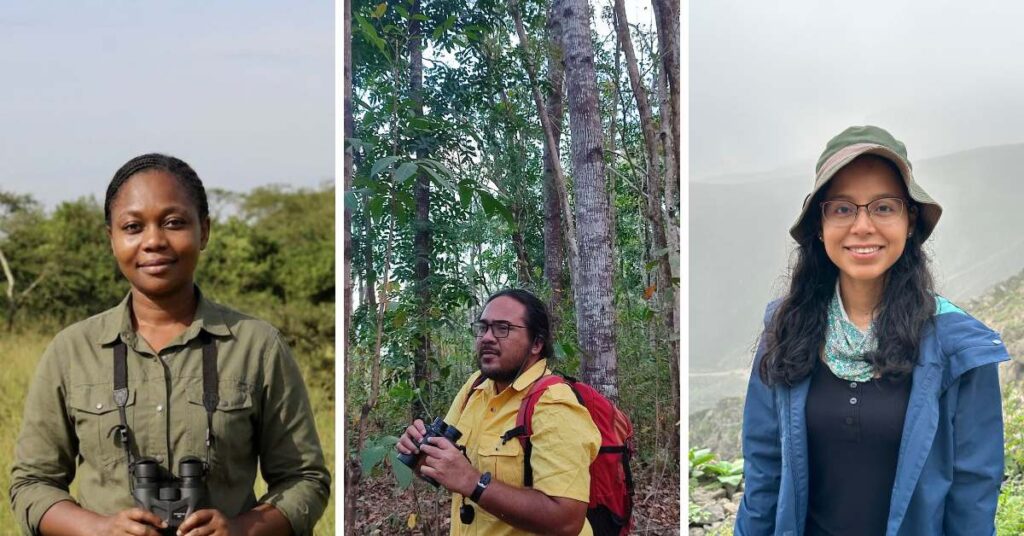
That setback makes the 2025 field season all the more meaningful. Dr. Megan Murgatroyd and her team of researchers, Vanessa Stephen and Rebecca Muller, successfully placed all of their available transmitters this season, tagging an adult male in the Western Cape and a breeding pair in the Northern Cape. These birds are already providing incredible insights into how adult Secretarybirds behave during the breeding season—information that is critical to the species’ conservation and that has remained out of reach for researchers until now.
Teamwork Makes the Dream Work
Vanessa Stephens
Vanessa is an ecologist with extensive experience in African savannahs and the Southern Ocean, and has a particular passion for birds. She has recently returned from 14 months on sub-Antarctic Marion Island, researching the effects of a warming climate on ground nesting seabirds for the FitzPatrick Institute of African Ornithology, and assisting with Albatross and Petrel population monitoring. She has worked on numerous landscape-scale conservation initiatives, documented Anti-Poaching Units across Africa, and sailed to the Antarctic waters on the S.A. Agulhas II research vessel as a bird observer. Field research on Secretarybirds is right up her street. There’s so much still to learn about them, so every interaction holds value. In her spare time, Vanessa likes to hike, read, and paint.
Rebecca Muller
Rebecca developed a love for nature and animals at a very young age. During her undergraduate courses, she became interested in conservation and pursued a Master’s in Conservation Biology. It was during the Masters working on breeding in Crowned Eagles that she became interested in how raptors have adapted and been able to thrive in urban areas. She later worked on monitoring Black Sparrowhawks in Cape Town as part of a 20-year-long research project into their urban expansion. She recently completed her PhD on the effects of climate change on the timing of birds breeding in South Africa using a historical database. Rebecca is thoroughly enjoying being part of the HWI team monitoring Secretarybirds in transformed habitats in South Africa and learning more about these rather strange but beautiful raptors. In her free time, Rebecca can be found hiking, embroidering, reading, and spending time with her dogs.
What the Secretarybirds are Showing Us
Although it is still early—the birds have only been tracked for a few weeks —the Secretarybirds are already showing us that there really is so much we don’t know about these unique birds.
So far, both tracked males have remained relatively close to their nests, typically staying within 6–7 kilometers, with a maximum recorded distance of about 13 kilometers. The female’s behavior, however, tells a very different story. She has made repeated long-distance foraging trips—up to 30 kilometers—before returning to the nest.
These early findings suggest that Secretarybirds may require a larger range during the breeding season. As Meg and her team collect more data, they will be able to help inform how much space the species needs to successfully breed and survive.
A Number of Nests
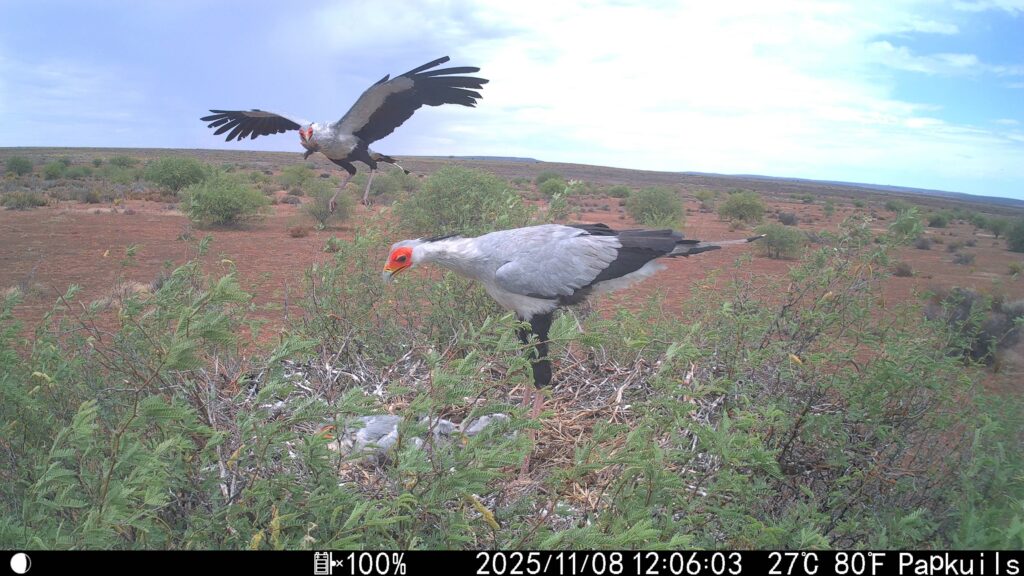
This season was notable due to the number of successful breeding attempts that the team documented through cameras and observation. While most of last season’s nests failed, six of the 10 pairs monitored successfully bred young.
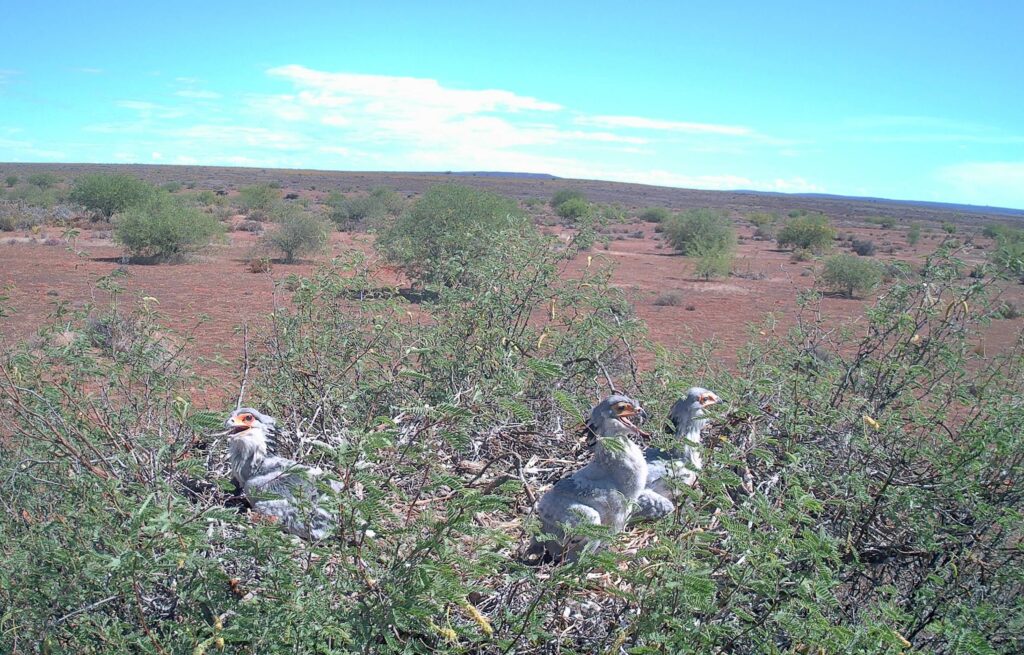
So far, the young at two nests have successfully fledged, while the team expects the chicks at the other nests to fledge over the coming month. That includes one nest that is currently home to three (!) Secretarybirds, the upper limit for the species.
“I was particularly excited to see that nest with three large healthy chicks,” Meg shared. “It’s a testament to the work that the landowners at Papkuilsfontein Guest Farm have done to create an environment that breeds success for this Endangered species.”
The 2025 Secretarybird Season, by the Numbers
| Nests Monitored | 19 |
| Nesting Attempts | 10 |
| Successful Nests | 6 |
| Chicks Hatched | 11 |
| Adults Tracked | 3 |
Collaborating to Conserve an Endangered Species
Conserving an Endangered species requires collaboration. HawkWatch International is incredibly grateful to the partners, landowners, local bird enthusiasts, and more who made this season possible.
HawkWatch International is especially thankful to those who sponsored the transmitters used to track the birds that were tagged this season. While collecting movement data is critically important to this species’ conservation, the units are costly, and this work would not be possible without their support. One of the adults is being tracked by a unit donated by Marshall Telemetry and the Mohammed bin Zayed Raptor Fund.
Make a Contribution to Conservation History
Although the 2025 Secretarybird season was a huge success for the species and its conservation, there have been some unexpected surprises. Like just how often these birds move.
Prior to deployment, transmitters are programmed to collect data at specific intervals, usually based on the animal’s movement. So far, the tagged adult Secretarybirds have moved far more often than expected—and more often than most raptors—meaning the team has collected far more data than they anticipated.
And all that data comes at a cost. About $120 a month.
By sponsoring a transmitter, you make it possible for us to continue collecting the data that will drive the understanding and conservation of this Endangered species. In addition to quarterly reports featuring maps and movement highlights, sponsors receive a high-quality photo of the species and the opportunity to name the bird for as long as they maintain their monthly commitment.
This blog was written by Kirsten Elliott, HWI’s Development & Communications Director. You can learn more about Kirsten here.