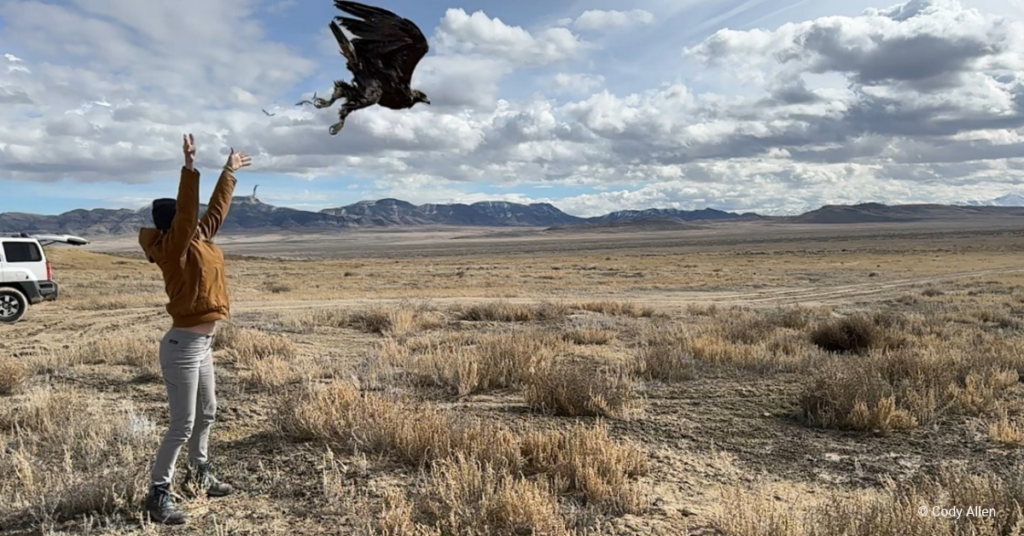
“All right, give ’em a toss!” Conservation Biologist Dr. Jordan Herman crouched first to give herself some momentum, then launched the 3.5-kilogram Golden Eagle, freshly accessorized with a metal USGS band from the Bird Banding Lab a blue-colored band with the alphanumeric “WV”), and a backpack-mounted satellite transmitter, into the air. We both stood in awe and respect for a few moments as the bird beat his wings powerfully to gain some lift in addition to the controlled take-off Jordan gave him.
Golden Eagles in the North American West face serious conservation issues. Habitat loss, diminishing resources from disease-driven population declines of both jackrabbits and mule deer, threat of electrocution from power lines, collisions with wind turbines, lead poisoning, vehicle strikes, and increasing parasite loads all together paint a grim picture for Golden Eagle survival. Nesting success has also taken a nosedive, which our Conservation Science Director, Dr. Steve Slater, wrote about in his recent blog post.
Though Golden Eagles are not listed as Threatened or Endangered, the many conservation concerns for this species are daunting. It is imperative that we learn more about these birds to potentially help them and prevent them from getting listed as such. However, Golden Eagles are challenging to study. They cover vast distances during the non-breeding season, and breeding territories can span 24,320 acres in often remote and difficult-to-access areas. Their nests often cling to precarious ledges on crumbling cliffs hundreds of feet high, and Golden Eagles are prone to abandoning their nest early on in the season from human disturbance. Flighted eagles are much more difficult to catch than most birds, due to a combination of wariness towards humans, their intelligence, large size and strength, and dangerously sharp talons. It is unsurprising, given these attributes, that for a long time, many aspects of Golden Eagles’ lives remained mysterious.
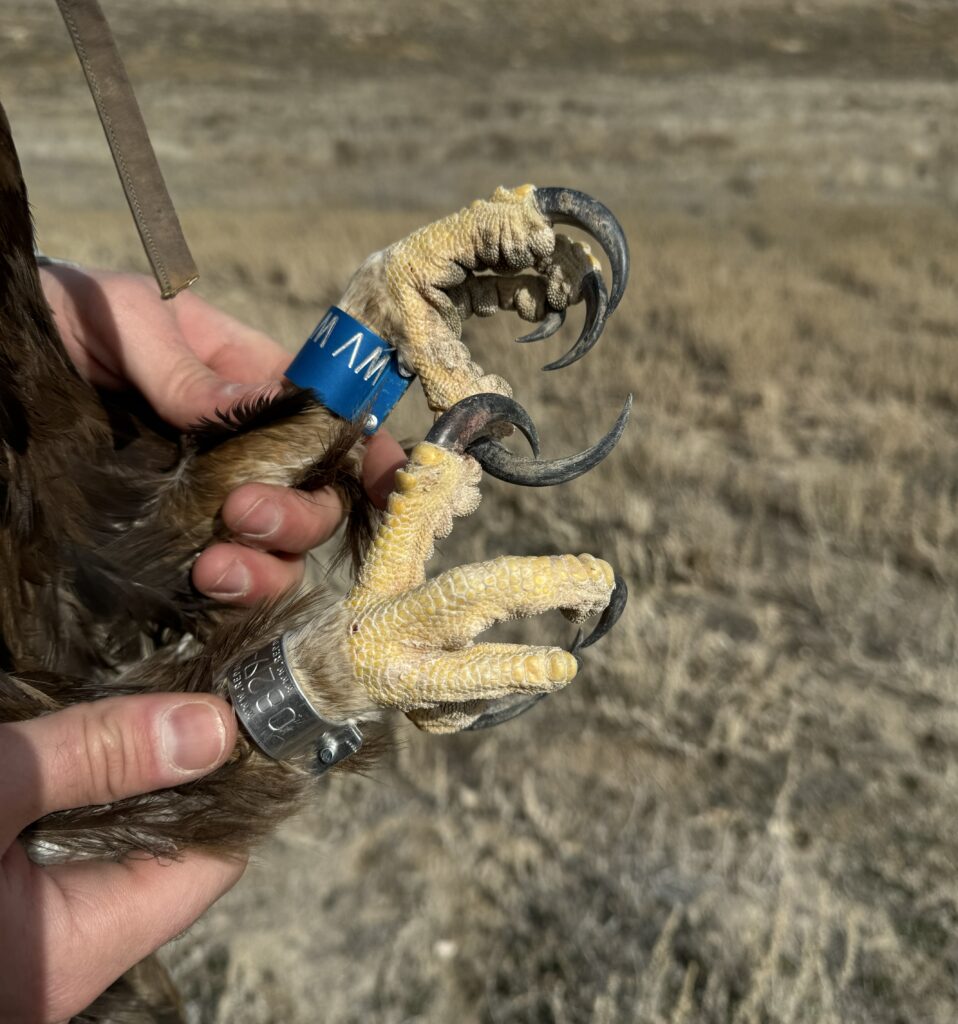
And so, as I watched WV fly away from our truck in the middle of the frozen muck of the West Desert just a couple of bumpy hours of a drive from Salt Lake City, I was filled with hope. The backpack-mounted satellite transmitter we placed on him shares his location every hour and can tell us where he will spend the rest of the winter. The tracks will tell us if he finds a breeding territory and nest, if he will favor busy roads for their roadkill scavenging opportunities, or the more far-flung remote patches of sagebrush for their grouse and jackrabbits. They’ll tell us if he’ll perch on utility poles or corral posts, or if he’ll migrate through wind farms or mountain ridgelines. Most importantly, the tag will inform us if he lives or dies. What he does, along with what the dozen or so eagles we are currently tracking with transmitters do, gives us valuable insight into how we prioritize our conservation efforts. As a young bird, WV can tell us a lot about how an eagle learns to survive in a very tough environment.
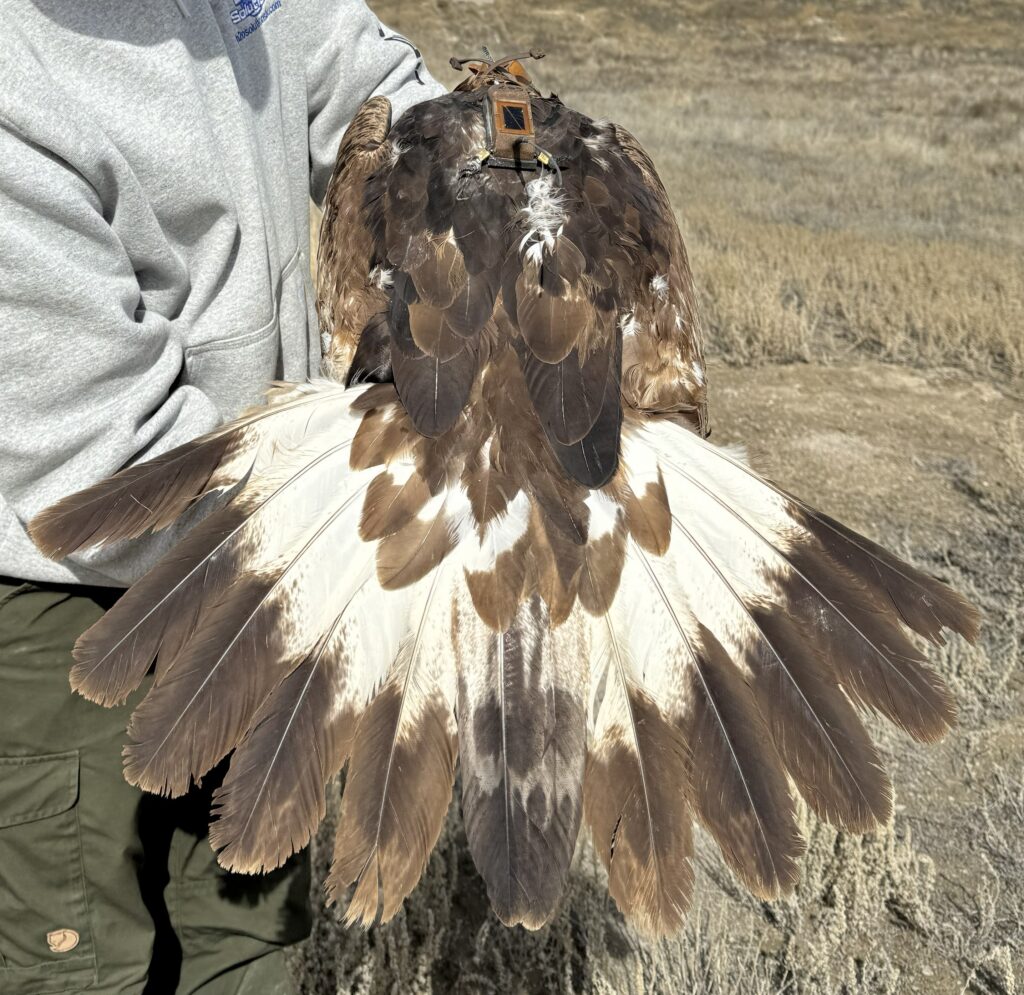
Satellite transmitters are particularly useful advances in the world of bird research, as they collect lots of data accurately, especially when compared to traditional “re-sighting” (where an observer sees a banded bird and accurately records the unique code engraved on the band). A small percentage of all banded birds are ever re-sighted, and rates for raptors are generally even lower. Each re-sight is incredibly powerful and often gives us great insight and something to add to the body of knowledge for each species, but they are few and far between.
Hawkwatch International’s Conservation Science Department has been augmenting such re-sighting efforts of banded Golden Eagles in the West Desert since 2023 with motion-sensitive trail cameras placed on eagle roosting locations to maximize potential re-sights. The region is sparsely populated and widespread, so the technology allows us to keep “eyes” on many locations with a high probability of encountering a banded bird without potentially spooking a bird away.
Fast forward to March 3, 2024, just 2.5 weeks after WV’s release, and lo and behold! One of these trail cameras snapped a photo of a bird… and darn tootin’, it was WV!
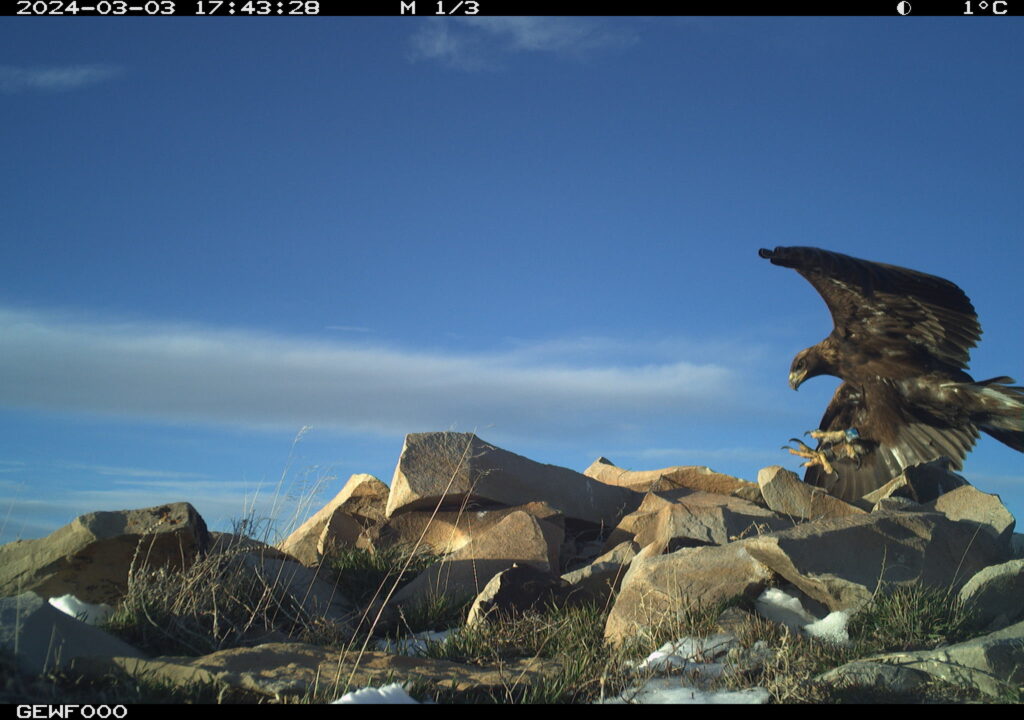
This photo helped me select sites for a project I was developing, now known as the Golden Eagle Winter Ecology project. In an effort to better understand how eagles behave over the harsh winter months and how the presumed scarcity of resources impacts Golden Eagle health, my project aims to place perches throughout the West Desert that are outfitted with a scale on top of the perch and a bit of homegrown technology (thank you to engineer David Slater) to record every instance that a critter lands on the perch. These “Passive Perch Scales” are coupled with a trail camera to capture photos of every perching event, confirming the species identification of the perching animal, and potentially resighting any banded eagles using the perch.
So, with the photographed visit by WV, we marked the site as a place to install a Passive Perch Scale the following field season.
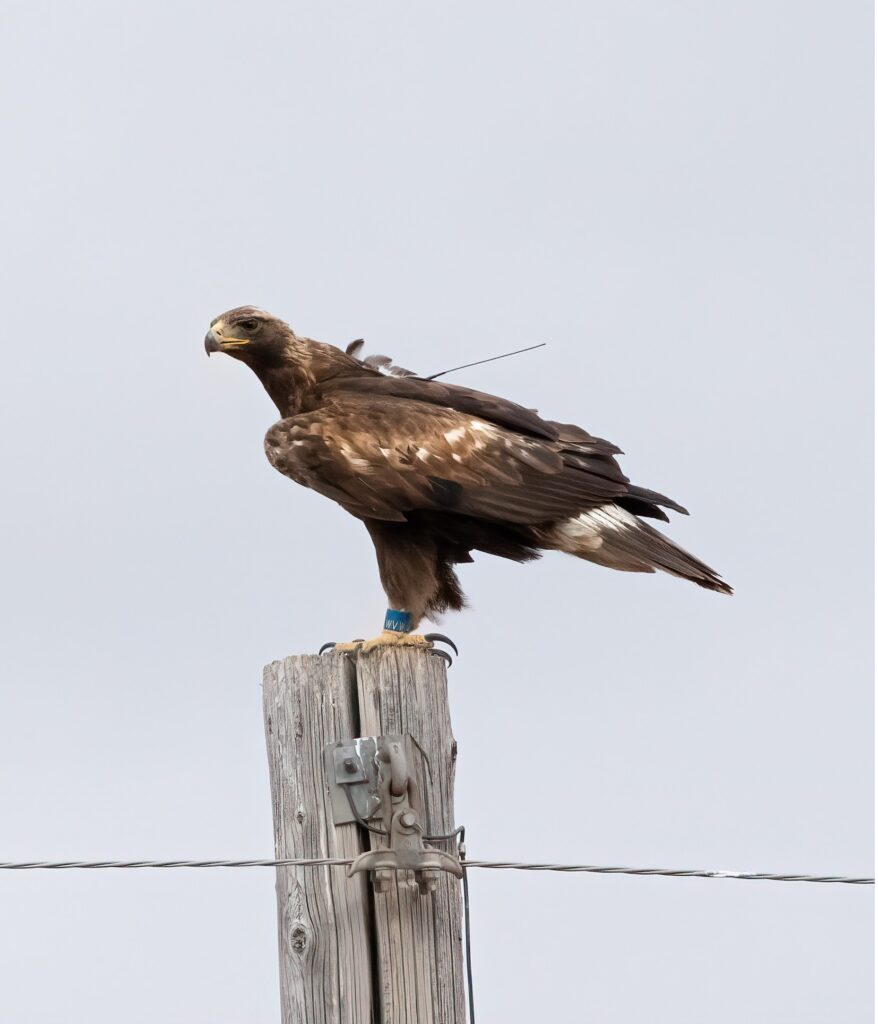
Just two months later, imagine our excitement when we received another photograph of WV, taken by Lizzie Wilson, a seasonal wildlife technician with Hill Air Force. To get a single resight of a banded bird is a celebratory event. To get a second resight, at a different location by a different observer several months apart, is astonishing. On top of that, WV’s young age had made him a less-likely contender for future encounters. Here in the Great Basin, over 53% of young eagles do not survive their first year of life, and of those that make it to their second year, only 81% make it to age three. After the third year, it stabilizes to around an 85% yearly survival rate. A young bird like WV was defying the odds!
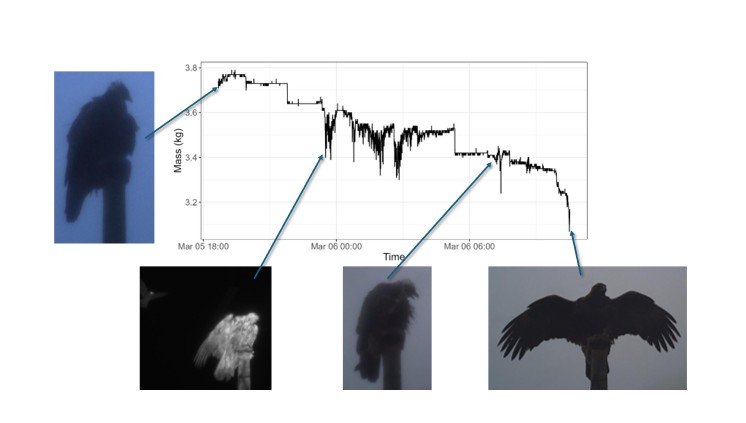
One year and two days after WV used the roost site with our trail camera (one year and 19 days post-capture), WV landed on a Passive Perch Scale a few miles away from the roost site on a dark and stormy evening and settled in for the night. Proving to be yet again a diamond in the rough, WV gave us an extraordinary glimpse into the secret lives of eagles. Out of 275 eagle perching events recorded by the Passive Perch Scales in that season, only four were overnight perching events.
WV and his accompanying data captured by the Passive Perch Scale show us just how dramatically a night of bad weather can impact an individual bird. Over the course of 16 hours, WV dropped from a high of 3.77 kilograms down to 3.24 kilograms. This loss of mass (14.06% of his starting mass) represents the energy stores WV burned through metabolically to keep warm and stay alive on that frigid, wintry night (our trail camera reported a low temp of 35°F) with freezing rain and owls swooping on him throughout the night.
Hold on, it gets better, because WV was not quite done surprising us yet. This past winter, WV paid nine visits to four different Passive Perch Scales over four months. The first visit, on December 11, 2025, was to the roosting spot where we originally observed him from trail camera footage. He weighed in at 3.80 kilograms, close to that maximum weight recorded during his overnight roost in the spring of the same year.
However, as anyone in northern Utah can attest, this past winter was a weather anomaly. Unseasonably warm temperatures and incredibly low precipitation likely combined to make survival extremely tough for eagles in the desert. These birds rely on the winter mortality of big game, which was likely reduced thanks to the mild winter, leading to higher competition among wintering eagles for this resource. Though WV toughed it out and continues to move, the weight data collected by the Passive Perch Scales shows us that his survivorship came at a metabolic cost.
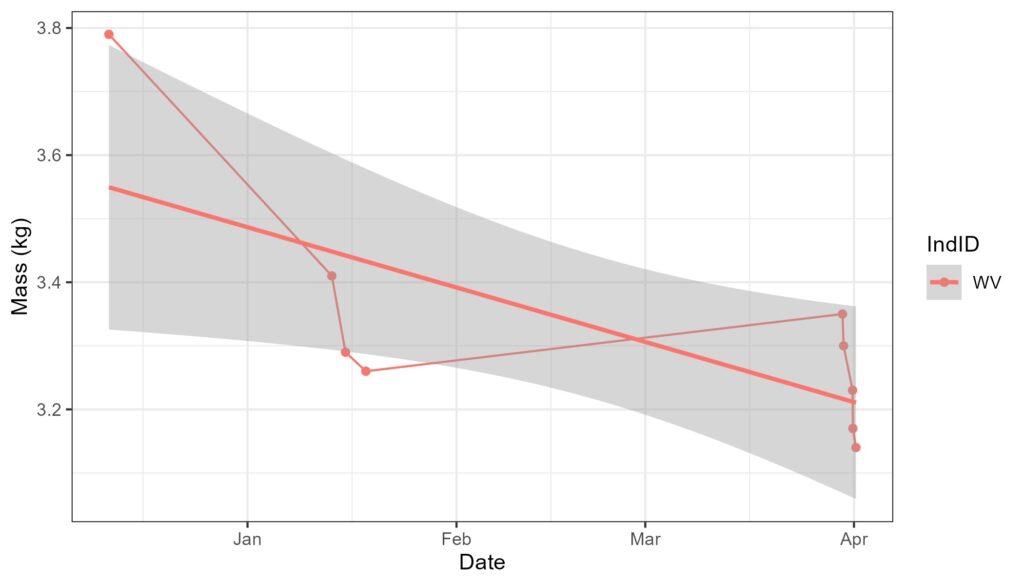
Over the course of the season, WV lost 650 grams, representing a season loss of 17 % of his starting mass. Thanks to his unique bands and transmitter, which allow us to assign an identity to the measurement data collected by the Passive Perch Scales, WV gives us a glimpse into the hardships eagles faced this past winter that tracking data alone could only suggest.
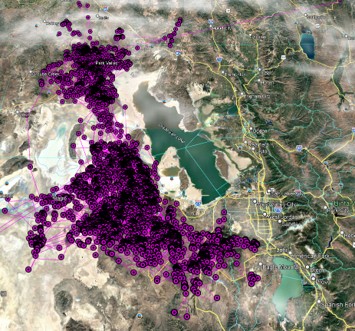
WV is a perfect example of why it is so important to look at conservation through multiple lenses. Through banding, transmitters, trail cameras, and our passive perch scales, we can paint a fuller picture of Golden Eagle health and what might be affecting it. If we only had our transmitters, WV’s relatively localized movements could suggest low pressure to leave the West Desert, but his gradual decline in mass showed resource scarcity and probable energy conservation. The greater context we have to work with, the better conservation actions and recommendations we can make to government agencies.
Though WV is still a young bird approaching adulthood, I believe he represents toughness. He represents the will to survive, to beat the odds, to face hardship head-on and say, “I will beat the rain out of my feathers and fly again tomorrow”.
I think we haven’t seen the last of him yet.
EDITORS NOTE: On September 21st, WV’s transmitter signaled that he stopped moving. Cody went to check on the bird and tragically found WV dead along a roadway, not too far from a road-killed deer carcass. Collisions are one of the top causes of eagle deaths, which is why we started our Eagle Vehicle Strike program: a project that moves roadkill away from roadsides so scavengers, like eagles, can feed safely. If you want to help protect Golden Eagles, join our Golden Eagle Camera Club. You’ll sponsor a camera used during our winter fieldwork, and at the end of October, you’ll receive photos your camera took along with a letter from Cody recapping the field season. Click here to conserve Golden Eagles: https://hawkwatch-international.myshopify.com/products/eagle-camera-club
This blog was written by Cody Allen, HWI’s Field Biolgist You can learn more about Cody here.