HawkWatch International celebrates 40 years of raptor research, education, and conservation this fall. Over the last several months, we’ve been flipping through old files, digging up old images, and revisiting stories from the people who have shaped HWI’s history.
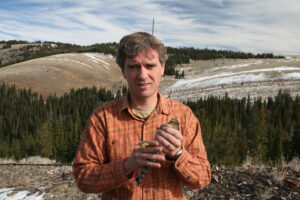
While the list of those individuals is lengthy, few have watched HWI’s evolution as closely as Dr. Steve Slater, who celebrates his 20th anniversary this Friday. Having worked at HWI for half our history, we decided to sit down with Steve to hear his perspective on how HWI has grown and where he hopes we head over the next 20 years.
How did you end up at HawkWatch International?
Honestly, I had just finished up my PhD bird work in Wyoming and was looking for a post-doc position or similar short-term position to figure out what was next. A friend of mine had worked at HawkWatch International (HWI) and spoke highly of the organization. I also thought if you are going to work with birds, raptors are the top! Suffice it to say, the temporary 2-year job I took got extended just a bit…
What are you most proud of 20 years later?
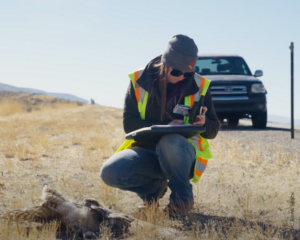
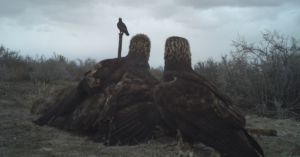
Wow, it’s hard to pick just one thing, but overall, I’m really proud of the novel work we’ve done with our Golden Eagle mitigation work, both the Eagle Vehicle Strike and Winter Ecology projects. Both of these projects have moved from an idea that seemed really challenging to execute in terms of a rigorous scientific study, to a place where we are now providing clear and quantifiable benefits to eagles. The projects keep adapting and growing in interesting ways too, like our recent pioneering of the “passive perch scale” to weigh wild eagles without having to handle them.
The past 20 years have seen some of the biggest events in my personal life as well, including meeting my wife, building a home, having three boys, the passing of my dad, and more. Most people that know me well also know that I’m not bashful about talking about the fact that I’ve been sober for over eight years now, thanks to the people around me and the tools of meditation and mindfulness. I like to think that these tools and my journey have helped me be a better peer and mentor to those I work with.
How has HawkWatch International changed over the last 20 years?
So many ways! We’ve moved buildings (we used to share space in a building on South Temple where there would be weddings, blood drives, and more), we have more staff, more projects, and more impact. We’ve grown from one science department to three, including an International Program. We’ve grown from one educator to an entire team, and we now have a small army of volunteers that help with science and outreach. We are a much much bigger organization in very meaningful ways. When I first started working here, I used my own car to do nest surveys, often for days at a time with no reception or human contact. While it’s tempting to romanticize those times, I’m glad to see how we’ve grown and matured as an organization in ways that allow us to do important work more effectively and safely.
Where do you hope HWI is in the next 20 years, when it celebrates its 60th anniversary?
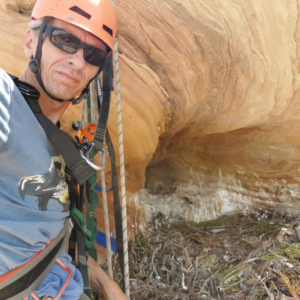
Whew, that’s a big vision question there, and it sounds like maybe we should form a committee to workshop this? First off, I hope someone else is doing most of the rappelling at that point. All joking aside, this question really isn’t that hard for me to answer, because I think we have been moving in the right direction for the past 20 years. We also have so many impactful and promising things that have recently developed or are newly on the horizon, including our International Program and grants, the Tucson property, our solutions-oriented research projects, in-depth education programs and more. For example, I’d love to see us continue to expand our support and funding for researchers and projects in underserved parts of the world. I’d love to see the Roost in Tucson become a major research and education hub in the southwest. I’ve love to see that our current Golden Eagle mitigation projects have continued to adapt and evolve to help their populations stabilize or even begin to grow. And of course, through it all, I believe we’ll still be counting raptors at our western migration sites to keep tabs on their population trends in an ever changing world.
What hasn’t changed? Why is that important?
Our mission has never changed, nor has the fact that everyone that works here is very passionate about raptors and their conservation. We’ve also always followed the science, which has allowed us to stay at the table with state and federal agencies, rather than being viewed as adversaries or an issue–based advocacy group.
What is the most important thing you’ve learned about raptors so far?
Again, it’s hard to pick one thing, but for me, I’ve really come to appreciate that individual raptors aren’t the facts we’ve gathered about them. I’ve really come to appreciate the individuality and variability within each species, and how circumstances and context need to be taken into account when managing a situation. Managers want hard and fast rules, like a ½-mile buffer around an eagle nest to protect it, for example. In reality, some eagles will need less, and some will need more, and we need to take the time to understand each specific situation rather than applying one-size-fits all approaches.
What’s your favorite part about working at HawkWatch International?
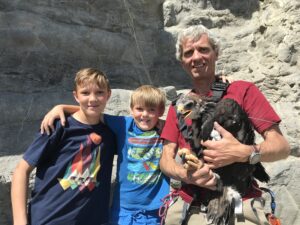
There are many days, both in the field and office, where I can honestly say that I am doing what I want to be doing, job or no job. I’m very grateful that I can say I love what I do for a living. I also really enjoy sharing our work with others, either in the field or through a program. Believe it or not, after many years, even rappelling into an eagle nest can start to feel like a job. But when someone sees an eagle up close for the first time, their excitement is contagious!
Lightning Round
Favorite Raptor?
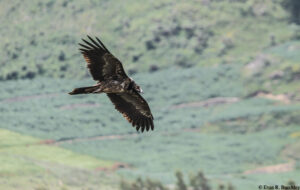
I feel compelled to say the Golden Eagle, since I know this species so intimately, but there are so many species that I love! One of my favorite experiences was seeing a lammergeier (Bearded Vulture) up close, flying past in the Pyrenees of Spain, back when I was studying grouse.
Favorite HawkWatch migration site?
Whichever one I’m at? Again, it’s hard to pick a favorite. I do have some special fondness for Commissary Ridge, since this was the first site I visited and we caught a Bald Eagle. I also worked nearby on my M.S. graduate studies of sage-grouse, years before coming to HWI.
Favorite Place to Bird Outside of HWI sites?
My backyard. I know I’m spoiled. I’ve seen American Goshawks, Golden Eagles, Red-tailed Hawks, Great Horned Owls, all kinds of songbirds and hummingbirds, not to mention the occasional moose, bobcat, and ermine.
Gear You Always Bring to the Field?
Binoculars. Never leave home without them! In more recent years, reading glasses have become an essential piece of field equipment…
Most Memorable Moment in the Field?
I’m grateful to be able to say there are many to choose from. To name just a few: there was that time I rappelled into an eagle nest wearing Chacos, only to discover a still living (but blind and agitated) snake in the nest; there was that time I pulled back the burlap screen on our trapping pit to find a coyote looking me in the eye from a foot away; and there was that time I was racing a pop-up storm with hail and lightning on the side of a cliff, trying to get an eagle nestling back to its nest quickly. Many memorable days of good company, good scenery, and more. I also have a few memorable days when I got five flat tires, or rolled my truck, and a few other things you’d prefer not to relive…
Learn more about how you can celebrate with Steve and the rest of the team this fall at https://hawkwatch.org/wings
This interview was conducted and edited for brevity by Kirsten Elliott, HWI’s Development & Communications Director. You can learn more about Kirsten here.